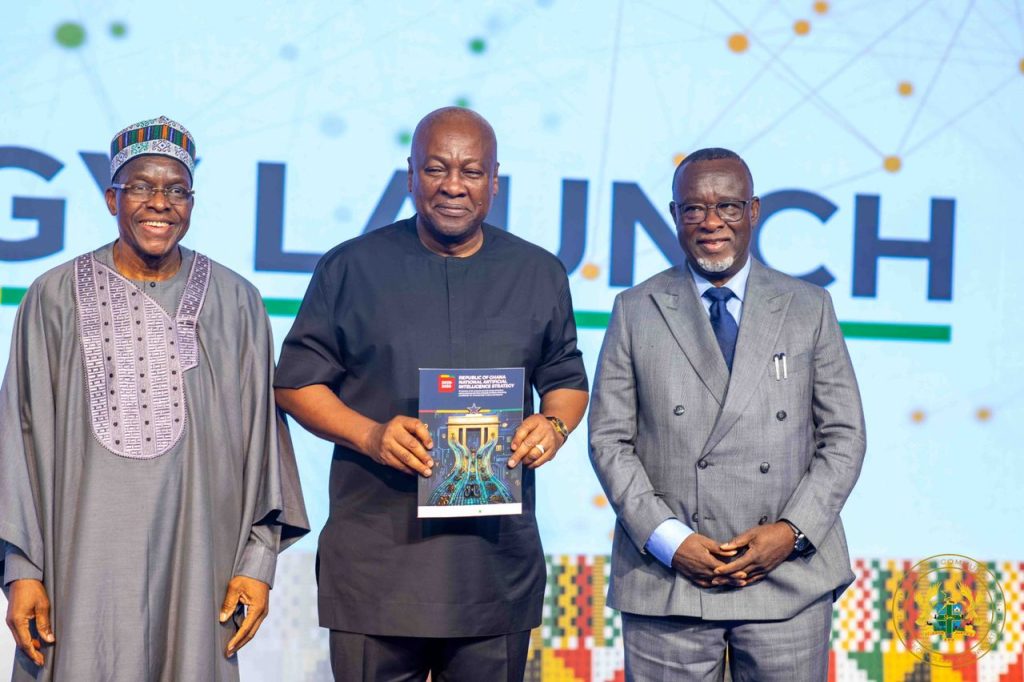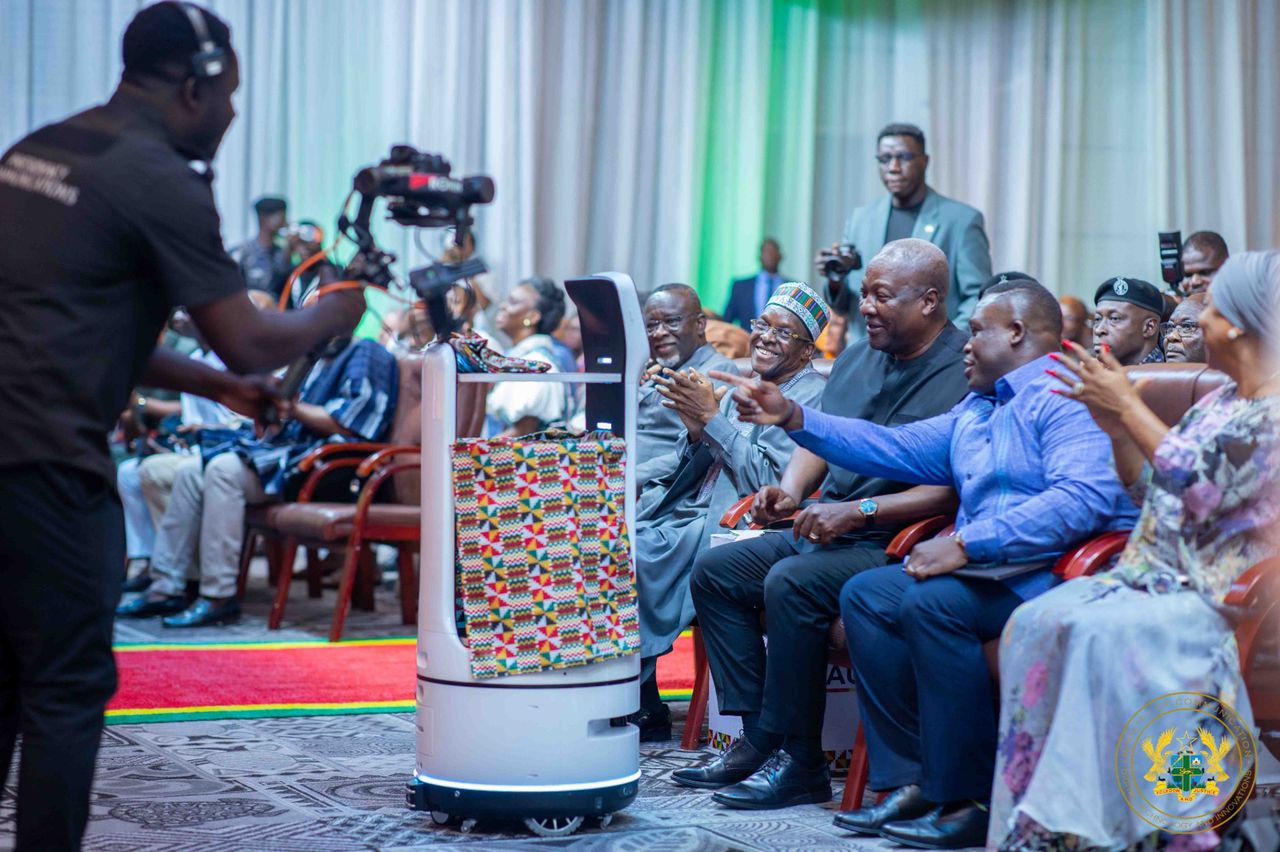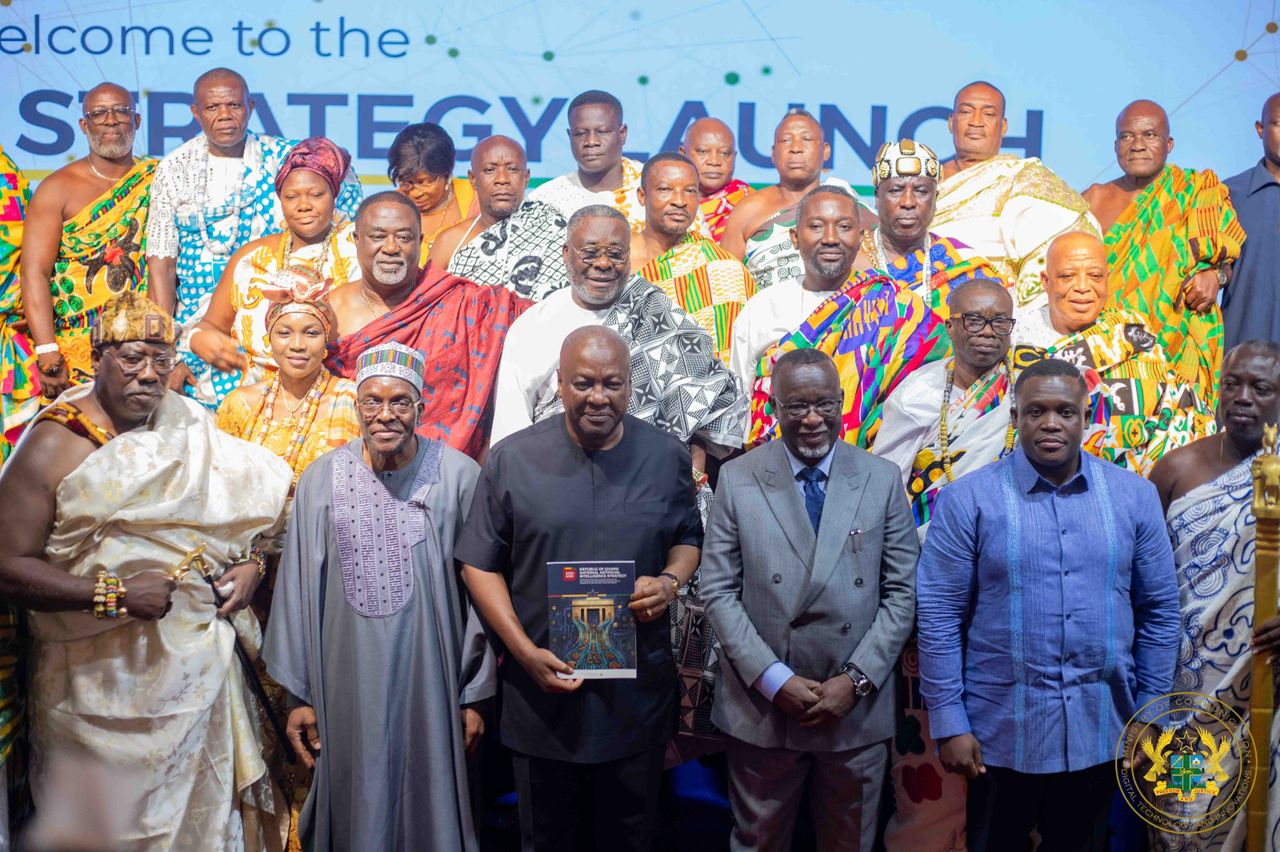
The President, H. E. John Dramani Mahama has launched Ghana’s National Artificial Intelligence (AI) Strategy, marking a decisive step toward positioning the country as an innovation-driven and globally competitive digital economy.
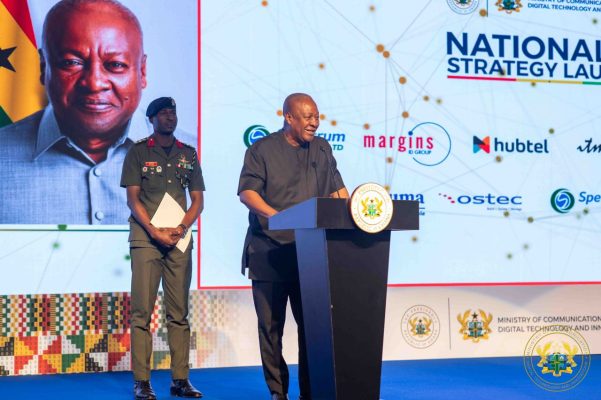
Speaking at the launch in Accra on Friday, April 24, 2026, the President described the strategy as a clear statement that Ghana will not remain a passive consumer of emerging technologies, but will actively design, govern, and deploy AI to drive national transformation.
He noted that global perceptions of AI have shifted from fear and uncertainty to purposeful adoption, stressing that technology is not destiny but shaped by human choices, policy direction, and responsible leadership. According to him, Ghana is determined to align with this forward-looking global trend by harnessing AI for good.
President Mahama highlighted the growing impact of AI across sectors, including healthcare, agriculture, education, security, and public service delivery, noting that the technology is already improving diagnostics, boosting productivity, and enhancing decision-making.
He emphasised that the key question for Ghana is not whether AI will shape the future, but how the country will shape its use in line with national values and priorities.
Addressing concerns about job displacement, he assured that government’s approach would focus on augmenting human capabilities rather than replacing them, guided by a human-centred and inclusive model of adoption.
The President outlined a clear vision to position Ghana as a leading AI hub in West Africa, driven by innovation, job creation, and inclusive development.
He disclosed that government has already initiated measures to ensure this vision translates into results, including AI training for ministers and the introduction of performance indicators across Ministries, Departments and Agencies to drive measurable adoption.
He further revealed that the 2026 budget prioritises AI deployment across critical sectors, with institutions such as the Ghana Revenue Authority already leveraging AI to improve efficiency, reduce errors, and strengthen domestic revenue mobilisation.
On human capital development, President Mahama underscored the importance of equipping Ghana’s youthful population with digital and AI skills through initiatives such as the One Million Coders Programme, aimed at building a strong pipeline of talent for the digital economy.
He also stressed the need to localise AI systems to reflect Ghanaian languages and cultural contexts, ensuring inclusivity and accessibility for all citizens.
The Speaker of Parliament, Rt. Hon. Alban Sumana Kingsford Bagbin, underscored that Artificial Intelligence was no longer a distant prospect but a defining force of our time, reshaping economies, governance, education, healthcare, and security with unprecedented speed and scale.
He noted that while its potential is immense, so too are the risks if left unguided. Drawing from history, he emphasized that every transformative innovation carries both promise and peril—AI can drive productivity, strengthen public service delivery, and unlock new opportunities, yet without deliberate stewardship, it risks deepening inequality, eroding public trust, and undermining democratic systems. He stressed that this moment calls not only for technological advancement, but for moral clarity, strategic foresight, and an unwavering commitment to national values.
He. further stated that Parliament stands ready to rise to this responsibility with urgency and purpose. He described the National Artificial Intelligence Strategy as more than a technical blueprint, but a social contract that places people at the centre of progress. According to him, it is imperative that innovation uplifts every Ghanaian while safeguarding dignity, privacy, and fairness.
He affirmed Parliament’s commitment to advancing forward-looking legislation that keeps pace with innovation, promotes accountability, and strengthens public trust. In doing so, he reiterated a clear national vision: that in Ghana, technology will serve humanity, reinforce democratic institutions, and expand opportunity for all.
The Minister for Communication, Digital Technology and Innovations, Hon. Samuel Nartey George (MP), in his remarks reiterated that, the strategy as a comprehensive development framework anchored on ethical AI, strong data governance, infrastructure expansion, and workforce readiness.
According to him the strategy was designed as a comprehensive development framework to transform critical sectors such as education, healthcare, agriculture, finance, and public service delivery. It emphasises responsible, ethical, and inclusive AI adoption, with strong governance structures to ensure data protection, fairness, and public trust.
The Minister also added that the Implementation will be driven through coordinated efforts across government, supported by institutions such as the National Information Technology Agency, Data Protection Commission, and Cyber Security Authority, alongside international partners including GIZ, UNDP, UNESCO, and KNUST Responsible AI Lab.
He reaffirmed Ghana’s ambition to become Africa’s AI hub through innovation, partnerships, and skills development, noting that the strategy marks a significant milestone toward building a more efficient, data-driven, and inclusive economy.
The Head of UNESCO Office in Ghana, Mr. Edmond Moukala, stressed that Ghana was not merely adopting a policy; it was making a bold statement about its future—a future where innovation is married to equity and where technology serves the collective progress of all Ghanaians.
”A country as rich in heritage, linguistic diversity, and intellectual history as Ghana cannot afford to have its identity diluted by global algorithms. UNESCO strongly believes that AI must be culturally grounded. For AI to be truly inclusive, it must understand and respect local knowledge systems. It must speak the languages of the people—from Twi and Ga to Ewe and Dagbani. Culture is not an ornament; it is the very soul of development. By ensuring that this strategy reflects Ghana’s unique cultural landscape, you are ensuring that AI becomes a tool for empowerment rather than displacement” ‘ Mr. Moukala stated.