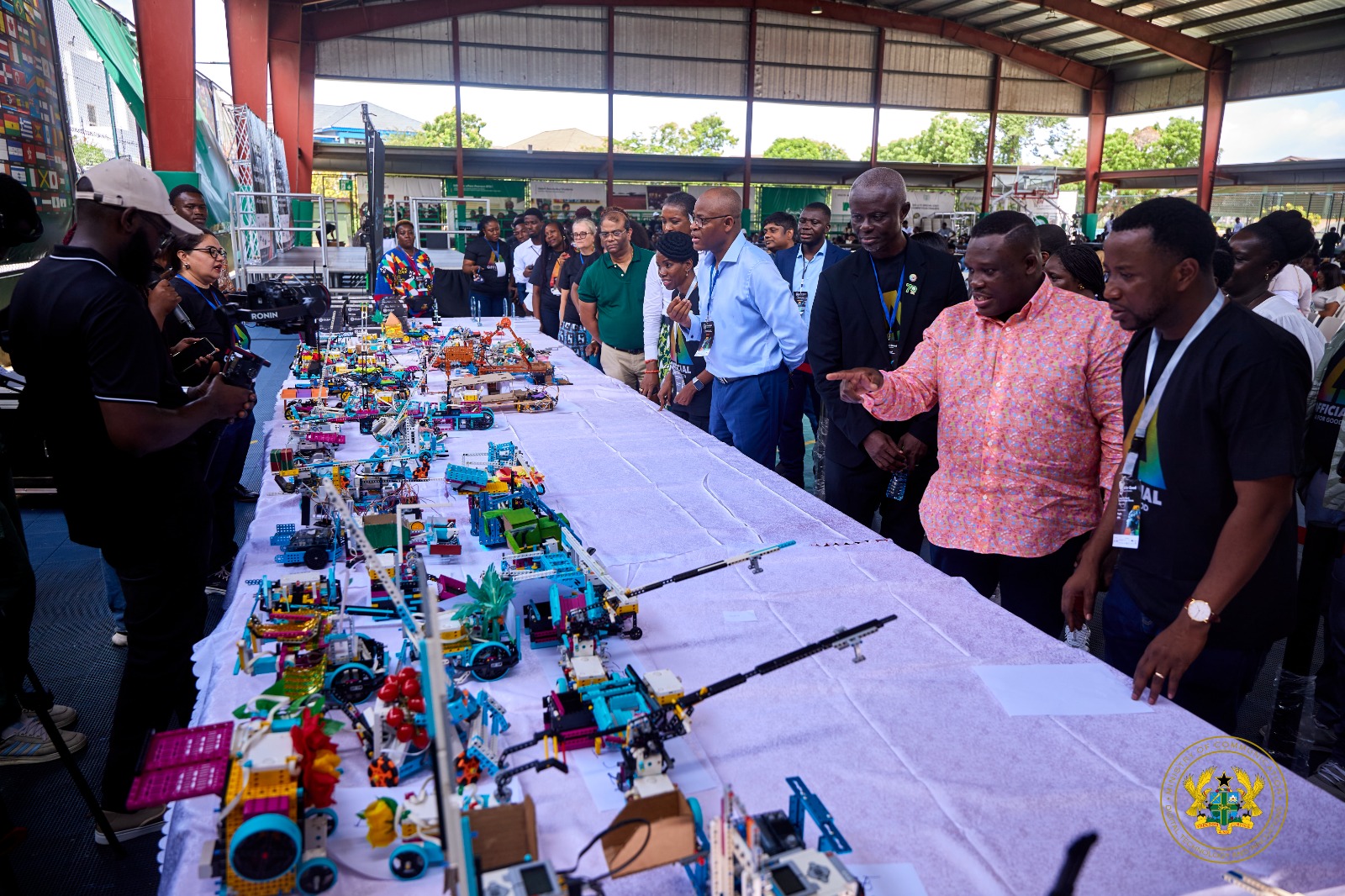
Ghana’s Minister for Communication, Digital Technology and Innovations, Hon. Samuel Nartey George (MP), has called on young Ghanaians to embrace artificial intelligence (AI) and robotics as powerful tools for innovation, problem-solving, and national development.
Speaking at the 2026 Robotics for Good Youth Challenge Ghana National Qualifiers held at the Ghana International School GIS in Accra, the Minister stressed the need to equip young people with practical digital skills and critical thinking abilities through hands-on technology competitions and innovation-driven learning.
The competition, organised by the International Telecommunication Union (ITU) in partnership with MakersPlace, brought together 45 teams, comprising 28 junior teams and 17 senior teams, to develop robotic solutions around this year’s theme of agriculture and food security.
Addressing participants, the Minister reminded the students that the true value of the competition extends far beyond winning trophies or medals. According to him, earning a place at the national qualifiers alone reflects dedication, courage, and a willingness to learn.
“Whether you come first or not, you are already winners,” he told the students. “Your presence here shows curiosity, determination, and the confidence to challenge yourselves.”
Hon. Samuel Nartey George also advocated for robotics competitions to become more institutionalised across the country, suggesting that such initiatives should evolve into regular national programmes that continuously nurture interest in science, technology, engineering, and mathematics (STEM).
He noted that platforms like the Robotics for Good Challenge help young people transition from simply consuming technology to actively creating solutions that can address real societal problems.
The Minister further reaffirmed government’s commitment to investing in initiatives that build digital skills and prepare Ghanaian youth for emerging opportunities in AI, robotics, and the broader digital economy.
Also speaking at the event, Elsie Effah Kaufmann, Dean of the School of Engineering Sciences at the University of Ghana, highlighted the importance of experiential learning in complementing classroom education.
She explained that competitions such as the Robotics for Good Challenge expose students to real-world problem-solving while helping them develop critical life skills such as teamwork, resilience, creativity, and analytical thinking.
“These activities expose you to practical problem-solving beyond what is taught in the classroom,” she said. “You learn how to collaborate, think critically, and design solutions that can make a real impact.”
Prof. Kaufmann also praised the creativity and innovation demonstrated by the participants, adding that Ghanaian students continue to prove their potential on international platforms. She expressed confidence that with the right support and investment, Ghana can nurture globally competitive talent in robotics and AI.
Chief Executive Officer of MakersPlace, Douglas Ayitey, also addressed participants and outlined the structure of the competition.
He explained that teams were tasked with designing autonomous robotic solutions capable of addressing challenges within the agriculture and food security sectors.
Mr. Ayitey encouraged participants to remain persistent even when faced with technical difficulties, describing setbacks as a natural part of the innovation journey.
“Robotics is not only about technical ability,” he said. “It is also about resilience, teamwork, and problem-solving. Even when things go wrong, you keep improving and trying again.”
He further disclosed that the best-performing teams from both the junior and senior categories would go on to represent Ghana at the global finals in Geneva, where they will compete with teams from across the world.
The Robotics for Good Youth Challenge is part of a global initiative aimed at empowering young people to use emerging technologies to solve pressing societal challenges while positioning them as future leaders in the digital economy.