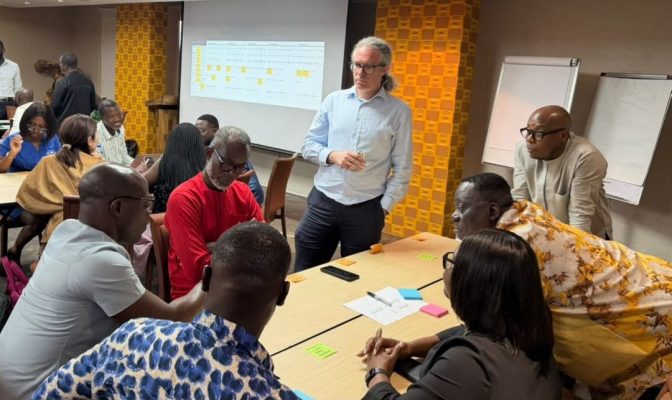
There was a quiet but important shift in tone as government officials, digital experts, and development partners gathered at Peduase Valley Resort to begin a three-day workshop on the future of the Ghana.gov platform.
From the very first session, it became clear that the focus was something much more practical, with the key question of how can we make government services easier for ordinary Ghanaians to access and use.
Participants from across Ministries, Departments and Agencies sat side by side with the NITA team, the Ghana Digital Acceleration Project GDAP Project Coordination Unit, the World Bank, the
Tony Blair Institute and the UK consultancy Public Digital.
The goal was simple but ambitious: rethink
how government shows up for the citizen.
The opening conversations by Steve Davenport, World BankSenior Digital Specialist for Western and Central Africa, set the direction. Instead of talking about platforms and systems, the discussions centered on people, the long queues, the confusing processes, the multiple stops citizens often must make just to complete a single task.
There was a shared recognition in the room: things can be simpler. The Ghana.gov platform, has the potential to bring services together into one place, but only if institutions work together and design
services as one government, not as separate entities.
That idea of a more connected experience, where a citizen doesn’t have to “figure out government” to get something done, kept coming up throughout the day.
Sessions led by Edwin Amoako the GDAP PCU coordinator, Solomon Richardson Infrastructure specialist with NITA, James Stewart and Praise Olutuase of Public Digital, and Amber Rosier Senior Advisor with the Tony Blair Institute, introduced practical examples from other countries like the UK’s
GOV.UK and Rwanda’s Irembo, showing what works when governments take a more coordinated and user-focused approach.
Beyond the presentations, what stood out most was the conversation.Participants spoke openly about the current gaps that slows processes down, what confuses users, and where systems don’t quite connect the way they should.
The focus then shifted to what could be better. By the end of the opening day, the energy in the room had changed. What started as a technical discussion had turned into something more collaborative, almost like a shared problem everyone was now committed to fixing.
The real work begins over the next two days, as participants move from conversations into hands-on exercises to redesign priority citizen services.
Day 1 did something important, which was to get everyone aligned. Not just on what needs to change, but on why it matters.Because at the end of the day, this isn’t about a website. It’s about making life a little easier for the people who rely on these services every day


