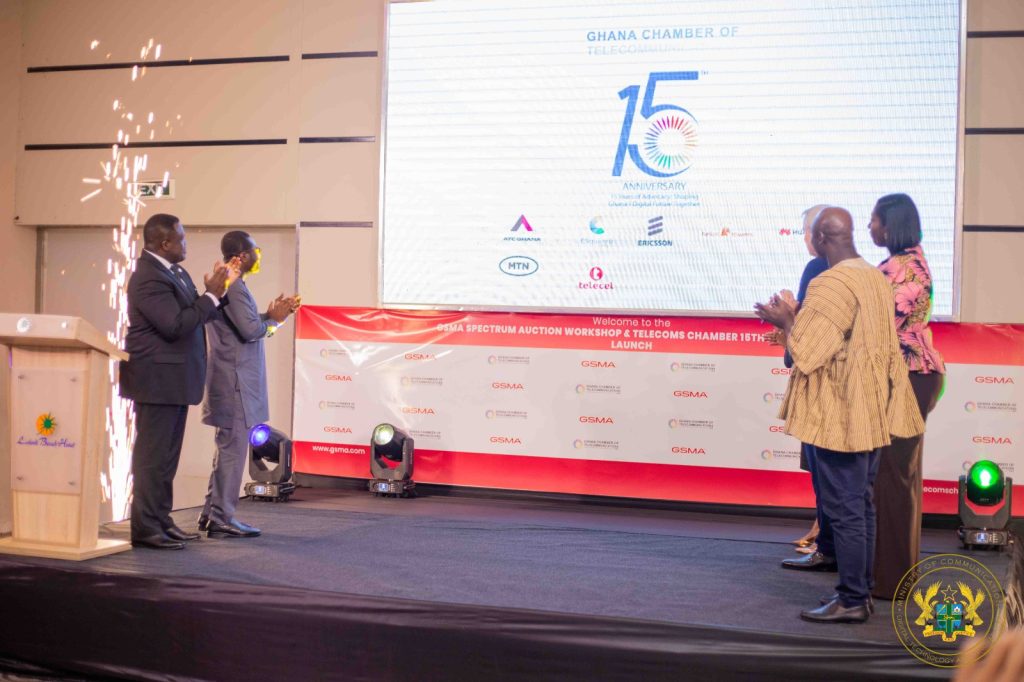
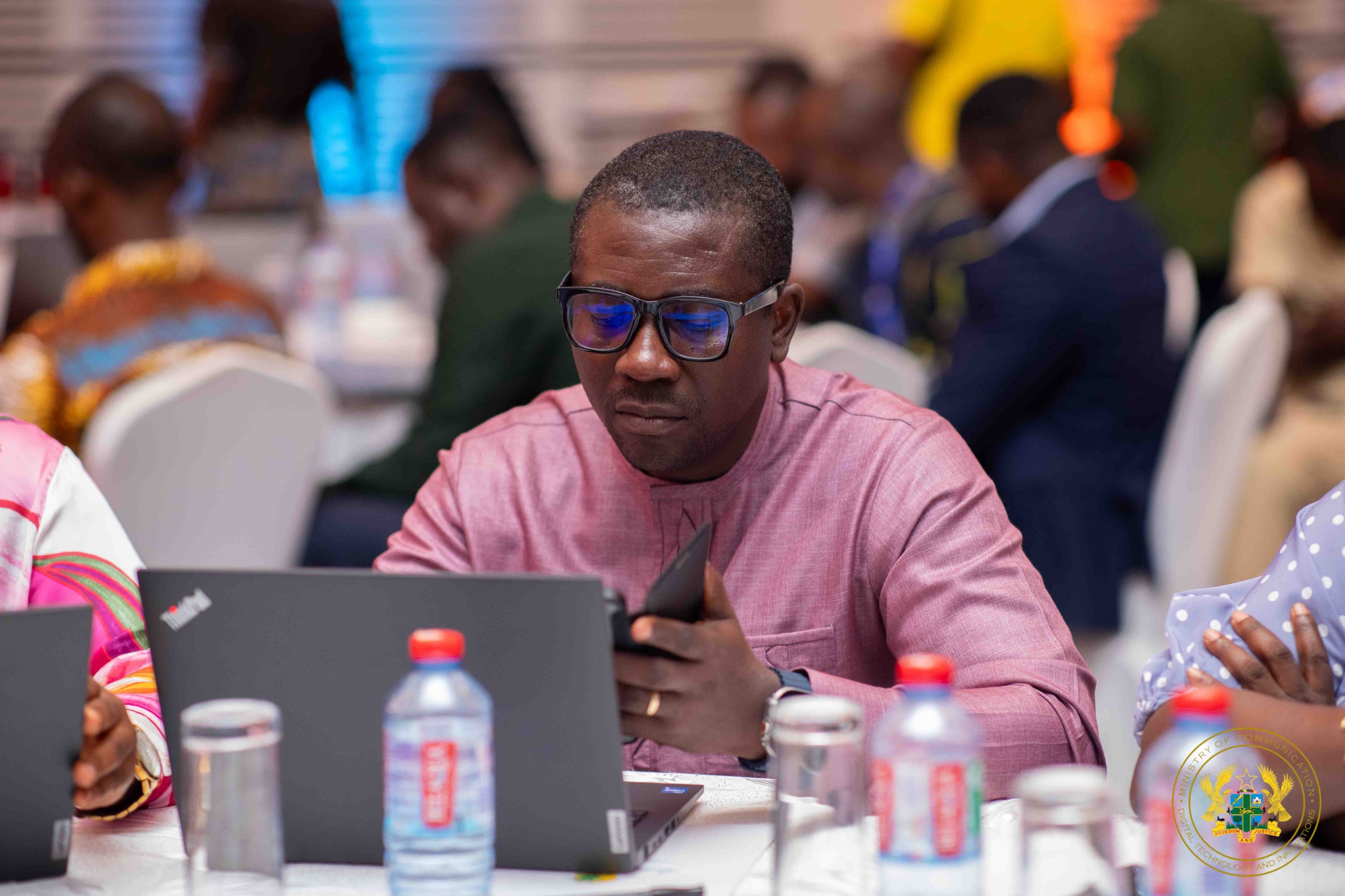
The Minister for Communication, Digital Technology and Innovations, Samuel Nartey George (MP), has called for a carefully balanced approach to spectrum auction design and pricing to accelerate Ghana’s 5G rollout while safeguarding long-term industry investment.
Speaking as Special Guest of Honour at the 15th anniversary of the Ghana Chamber of Telecommunications and a high-level workshop on spectrum auction strategy in Accra, the Minister underscored that spectrum remains a finite national resource whose allocation must prioritise deployment, inclusion, and value for citizens.
He announced that Government is targeting 70 per cent 5G population coverage by March 2027, cautioning that spectrum pricing must not “choke the very investment needed to deploy it.”
Highlighting Ghana’s ongoing digital reset under H. E. John Dramani Mahama, the Minister outlined key pillars including legal and regulatory reforms, digital infrastructure expansion, the National Artificial Intelligence Strategy, and skills development initiatives such as the One Million Coders Programme.
He further revealed that Cabinet has approved a shift toward a competitive national spectrum auction framework, while maintaining a wholesale model to encourage broader participation in next-generation service delivery.
Hon. Nartey George also stressed the need for concrete outcomes, cautioning against extended deliberations without action. He stated that the workshop must deliver actionable, time-bound results, noting that within 30 days, stakeholders are expected to produce clear policy and technical recommendations for implementation by the National Communications Authority.
He urged participants to adopt a pragmatic and forward-looking approach by rigorously interrogating data, challenging outdated assumptions, and proposing practical models aligned with Ghana’s 5G ambitions.
Hon. Nartey George challenged the Chamber to assume a more transformative role in shaping the country’s digital future. He called for stronger collaboration among operators, particularly in infrastructure sharing and long-term spectrum strategy, to expand connectivity in underserved areas.
The Minister emphasised the long-term significance of decisions taken at the workshop, urging stakeholders to act with urgency and unity in building a spectrum regime that supports investors, innovators, and the broader Ghanaian population.
The Chief Executive Officer of the Ghana Chamber of Telecommunications, Madam Sylvia Owusu-Ankomah, emphasised that decisions on spectrum policy will directly shape Ghana’s digital competitiveness, investment climate, and service quality for years to come.
She noted that spectrum is fundamental to delivering robust digital services and urged stakeholders to treat the discussions not merely as technical deliberations but as a national development conversation.
According to her, the Chamber was putting measures in place to reposition and rebrand itself to reflect the evolving digital ecosystem, while committing to support transparent policymaking and deeper industry collaboration as Government advances an ambitious programme of legal reforms.
The Director-General of the National Communications Authority (NCA), Rev. Ing. Edmund Yirenkyi Fianko, stressed the need for spectrum auction frameworks to include strict rural connectivity obligations, insisting that operators must be mandated to deliver services beyond urban centres.
He highlighted that future allocations must integrate infrastructure sharing, energy resilience, and cybersecurity readiness, while calling for candid stakeholder engagement.
The Chief Executive Officer of MTN Ghana, Mr. Stephen Blewett, described the Chamber’s 15-year journey as one defined by partnership, resilience, and national impact, noting that the telecommunications industry has been central to connecting people, enabling businesses, and driving financial inclusion.
He stressed that the future of the sector lies in supporting AI-driven digital ecosystems, where connectivity powers intelligent systems across sectors such as agriculture, healthcare, and education.
Drawing on international experience, he added that Ghana stands out for its regulatory clarity and stakeholder collaboration, urging continued cooperation among industry players, government, and regulators to sustain growth and innovation.
The event brought together policymakers, regulators, industry leaders and international partners to deliberate on best practices in spectrum management, with a shared goal of ensuring that Ghana’s transition to 5G delivers inclusive, investment-friendly, and sustainable digital transformation.